“Are you ready for Lead?” had no defensible answer
I was having career conversations with no shared definition of what each level actually meant. A senior designer I was coaching toward Lead was clearly performing above their level. Their January review moved them from ‘Successful’ to ‘Exceeds Expectations’, and I’d already secured a mid-cycle review as an exception to a new annual-review policy so I could make their case to a compensation committee before the next full cycle.
I tried to write the case down and couldn’t.
I could feel they were ready. I couldn’t point to the rows behind the feeling. “Are you ready for Lead?” was just a judgement call I was making in my head, and a judgement call in my head is exactly what a compensation committee should reject. If I wanted promotions to be fair and repeatable rather than a function of how well I argued on the day, the bar had to exist on paper before the conversation. Otherwise I’d just be reverse-engineering it to fit the case I wanted to make.
The vague version is the one that fails you under pressure
The obvious fix was a competency matrix, so I built one. v1 defined responsibilities by level across six areas: craft and execution, business impact, strategic thinking, communication and visibility, stakeholder engagement, and team development. The central distinction was Senior to Lead. Senior is reactive: you execute the work you’re given, you provide updates and the rationale behind your decisions. Lead is proactive: you set the meeting, you drive the business outcome, you decide what should be solved, you mentor. I built it on one principle: promotion rewards behaviour you’re already showing. To move up, you have to already be demonstrating a share of the next level’s responsibilities.
On paper it looked complete. I shared it for team feedback and ownership, and ran it past my manager and an HR partner for wording. The structure worked. The specificity didn’t. The HR partner’s feedback was that phrases like ‘good grasp’ needed to mean something a person could act on. That was the early warning. The real test came when I sat down to actually plan the promotion.
The promotion exercise broke v1
Running the real promotion-planning exercise was where v1 fell apart. A row would say a Lead “thinks strategically” or “communicates proactively”, and I’d ask the practical question: what would the designer have to do this fortnight to show that, and how would either of us know it had happened? The matrix had no answer. The criteria described a finished state without saying what the evidence looked like or how to track it. The rubric read well in the abstract, but I couldn’t build a promotion case from any of it.
It also exposed another issue. “Strategic thinking” was a single row covering three different behaviours. A designer could be strong at one of them and the single row would hide the gap in the others, which is exactly the kind of thing that falls apart in front of a committee.
So I was honest with them. They’d been treating the Lead bar as lower than it actually was, and I hadn’t corrected that. I told them:
Carrying on as normal will not get you promoted. There’s a reason I’ve been pushing you to do certain things. — Me, during an frank conversation about promotion
They said they would have to start living in the real world’ and I offered a way forward; a tactical plan. It was an uncomfortable conversation, but afterwards both of us were finally working from the same definition of the Lead bar.
v2: every row spells out its own evidence
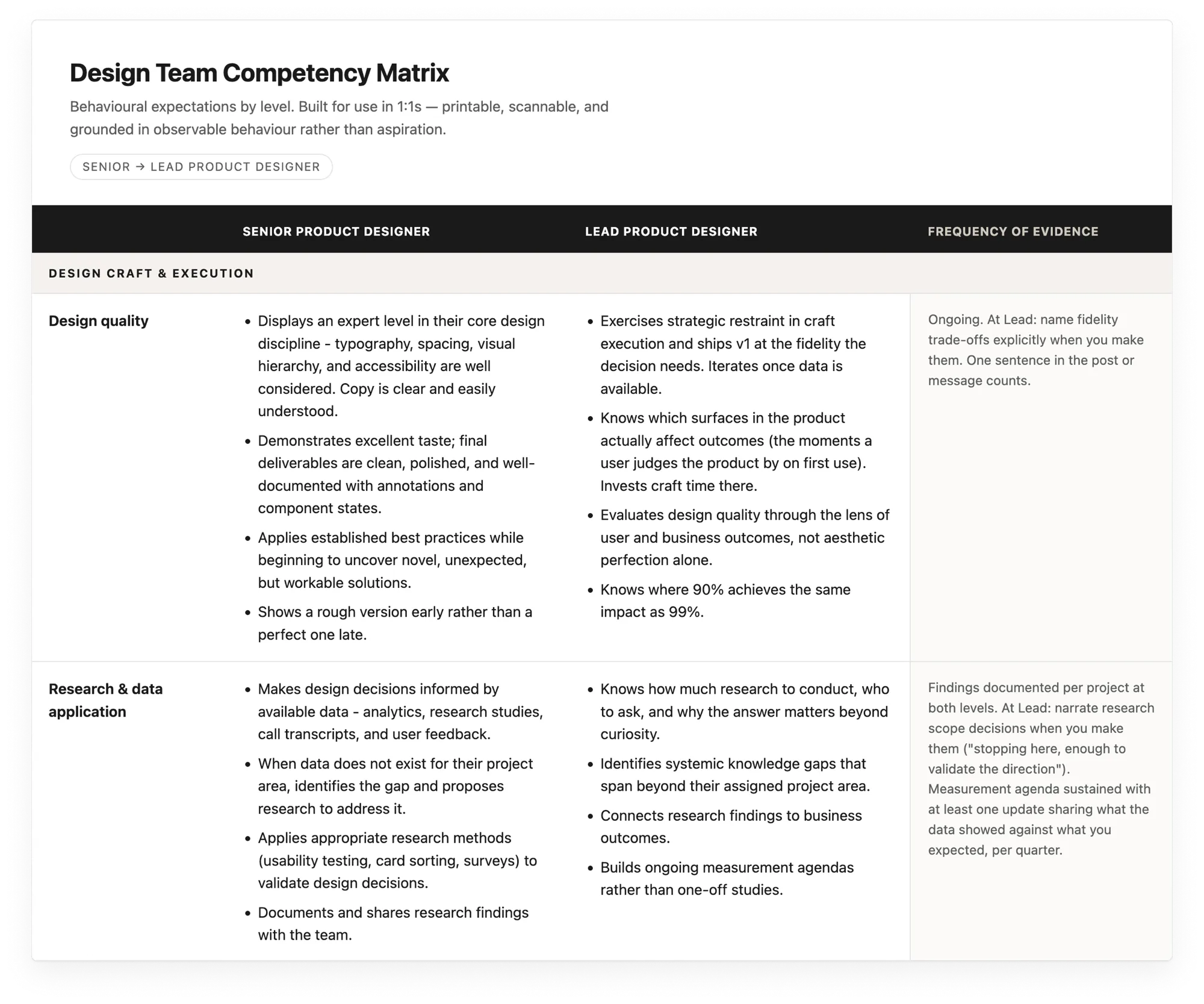
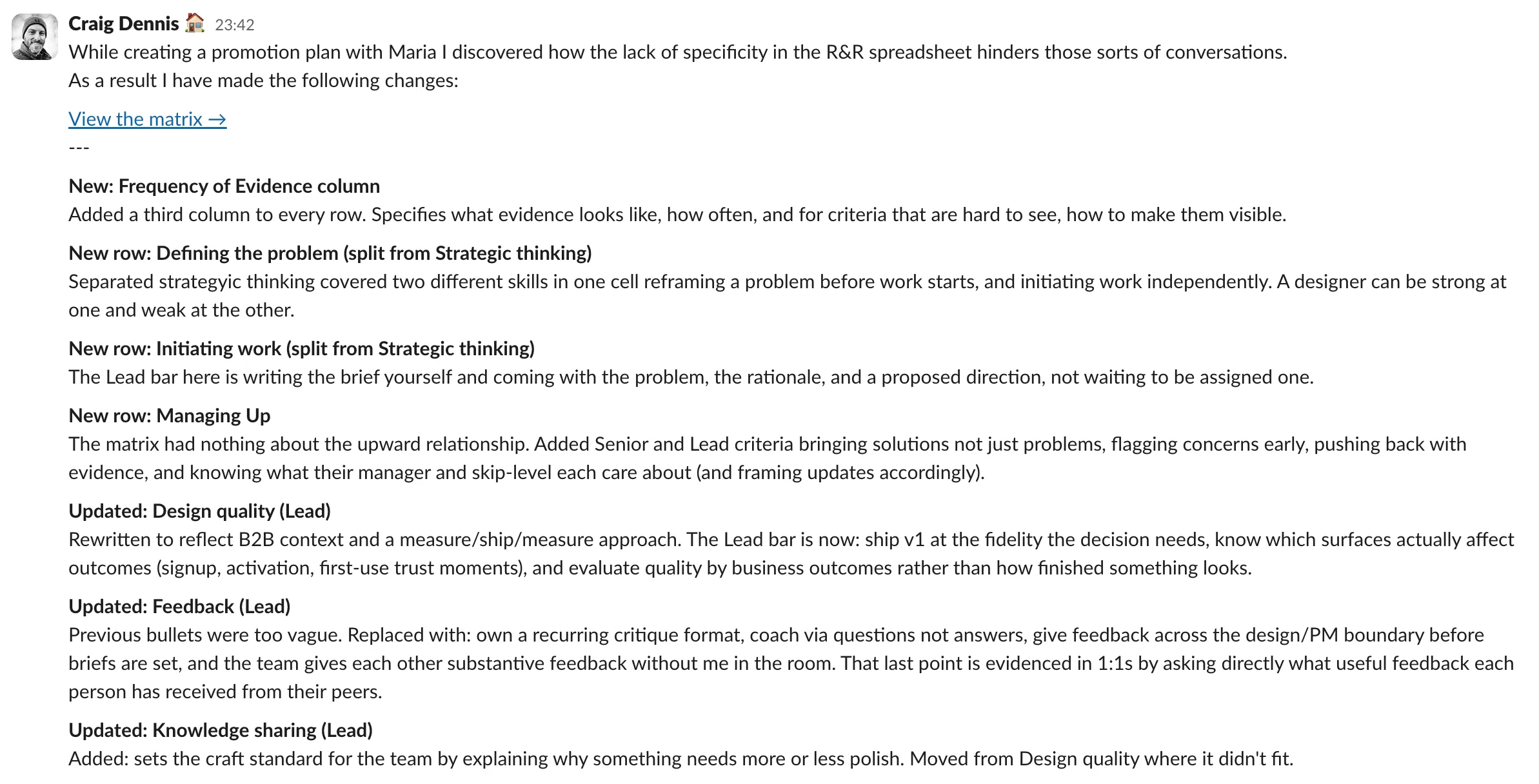
The fix was six changes to v1, all aimed at making every row something I could actually check. The biggest was a Frequency of Evidence column on every row. “Communicates proactively” is unverifiable; “communicates capacity-based deadlines cross-functionally, at least once per project” is something you can look for and log. The frequency column is what made each row checkable instead of aspirational.
After each iteration the business also needs to sign off on it. I spoke to HR and to the COO, incorporating their feedback in as well. Everyone has to agree on the terms so any promotion or underperformance has legitimacy from top to bottom.
Then I split the overloaded rows. “Strategic thinking” became Defining the Problem (reframing the work before it starts) and Initiating Work (writing the brief yourself instead of waiting to be assigned). I added a Managing Up row: bring solutions, flag concerns early, frame updates for your manager and skip-level. Separate rows mean one strong behaviour can’t mask a weak one, and each row gets its own development conversation. I rewrote the Lead-level Design Quality row for a B2B reality where you measure, ship at the fidelity the decision needs, then measure again, rather than polishing to 99% on surfaces that don’t move outcomes. I tightened the Lead-level Feedback row to specific, observable criteria, and pulled knowledge sharing out of Design Quality where it had been hiding.
The matrix was most effective in coaching, not just in reviews. I referenced specific cells in 1:1s. When a designer navigated something well, I called attention to the competency it matched. When someone missed, the matrix let me frame the gap as a behaviour to practise rather than a verdict on them.
They own their own promotion case now
v2 came out of real coaching, which was the right way for it to come out. A rubric is only useful if it continues to evolve to meet the needs of the team and the business. I versioned it (v1, v2) on purpose, so the team could see it as a living document rather than a fixed reference. I also made sure to solicit their input, feedback, and social contract that they will be held accountable to it as well as using it for promotion.
Next I write a three-part handover so I could stop doing the work on behalf of someone.
- A gap analysis mapping their current behaviour against each Lead row
- A set of specific actions to close the gaps that were left
- The evidence I’d already captured for each requirement on their behalf.
I’d been logging that evidence as the work happened, using Claude Code to pull and structure it, Granola for the 1:1 notes, and Obsidian to hold it in one place. I’ve since moved that workflow off Obsidian and onto mempalace; I wasn’t opening Obsidian to read notes anymore, so I’m focused now on capture and retrieval through AI rather than files I open by hand.
From the hand-over on, everything they did mapped to the Lead column. They own their own promotion evidence now. I can’t log it for them; a Lead drives their own case.
The mid-cycle review is the deadline, and for the first time the answer to “are they ready for Lead?” isn’t my opinion. It’s a column of evidence against a bar everyone agrees already agrees on.