How do you coach two designers who need opposite things?
Two of my designers were at the same level, and I was coaching them the same way. It was the obvious thing to do. Same title, same expectations, so the same conversation each week. The problem was that it worked for one of them and not the other.
That sounds like a soft people-problem, but it shows up on the business. A designer who isn’t being coached the way they actually learn ships slower, gets overlooked by stakeholders, and doesn’t grow into the level you’re paying them for. Across a team, that’s a function that looks fully staffed and still can’t ship fast enough. The cost of defaulting to one style is people not getting better.
So I stopped treating coaching depth as a function of seniority. Coaching depth varies by individual, not by experience level. Two designers with the same job title can need diametrically opposite coaching. Defaulting to one style is the failure, and I’d been defaulting.
Proof it was working
A designer a few weeks into the role earned stakeholder trust and credited the 1:1 coaching directly. The praise came unprompted from a senior leader who’d worked with them.
I couldn’t see my own coaching while I was doing it
Spotting a problem is easy, if you have the material from which to derive evidence. The hardest part for me was that I can’t watch myself coach. In the moment I feel helpful, I feel like I’m developing someone, and I had no reliable signal telling me whether I actually drew the insight out of them or just gave them the answer phrased as a question.
I started transcribing my meetings for the sole purpose of understanding my own performance.
My own philosophy made this harder. The way I lead is to point at the gap and let the designer close it, rather than give them the answer. That’s hard to live up to when I have strong opinions about what needs to be done. I’d end up giving them the answer myself. It felt like generosity. To the designer it’s just being told what to do, and they learn nothing about how to get there next time.
The question I couldn’t answer week to week was simple. Am I developing this person, or am I just talking? I needed some way to measure not only their progress but also my own improvements.
The answer was situational management
One designer responded to questions. With them I ran it Socratic: layered probing, the occasional role-reversal, sitting in the silence after an open question instead of answering it myself. The job there was to resist filling the gap, because they’d close it themselves if I waited.
The other needed something more concrete. Questions alone left them stuck, so I gave them an enumerated playbook: here are the steps, here’s the order, here’s what good looks like at each one. That still counts as pointing them at the gap, as long as they own the path the steps lay out and I haven’t pre-built the deliverable for them to copy.
My weekly scorecard caught me directing instead of coaching
To know whether the calibration was working, I started scoring my own coaching. Each week after an evaluated 1:1 I’d grade the session across a set of dimensions: coaching versus directing, my talk-time ratio, how many topics we tried to cover, whether I recognised a specific win, whether I’d actually had a career-development conversation, and whether the person left with something they owned. Trend arrows, week over week.
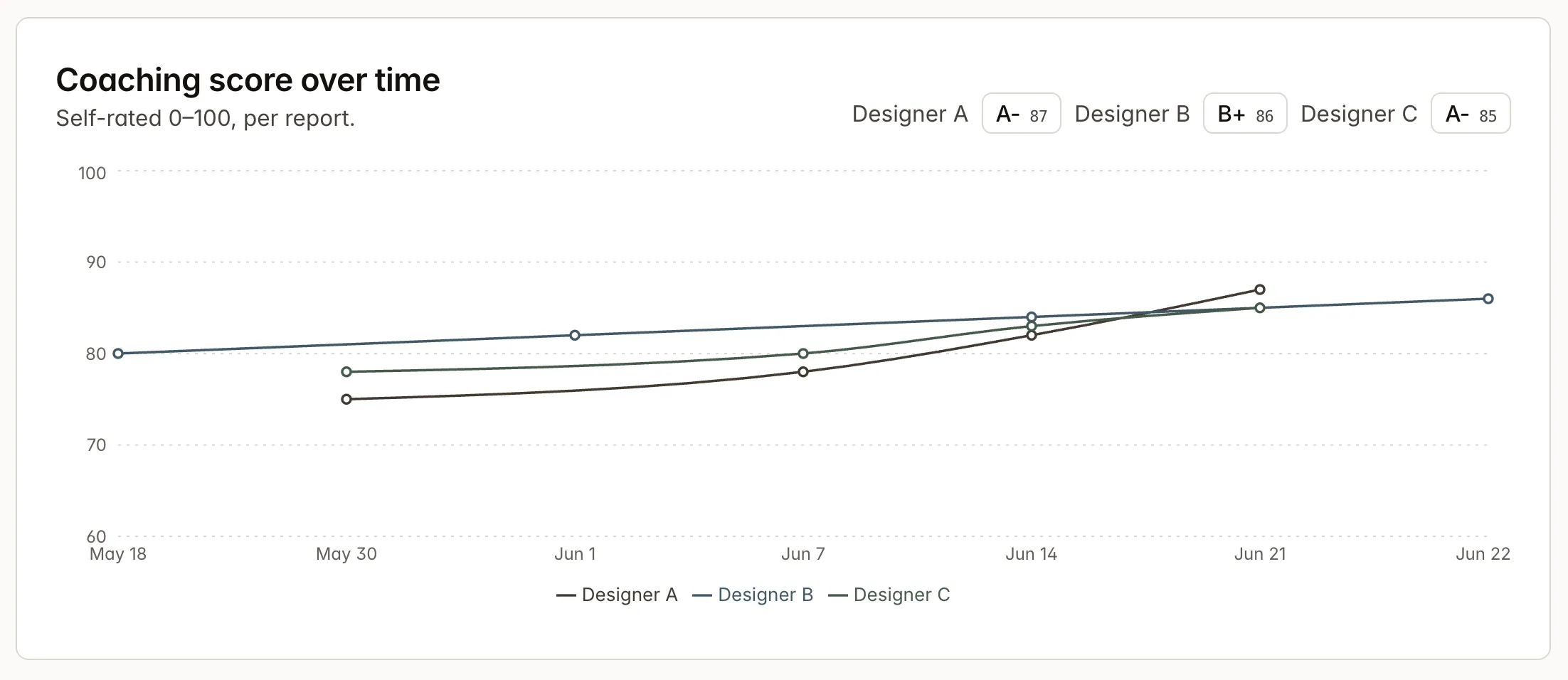
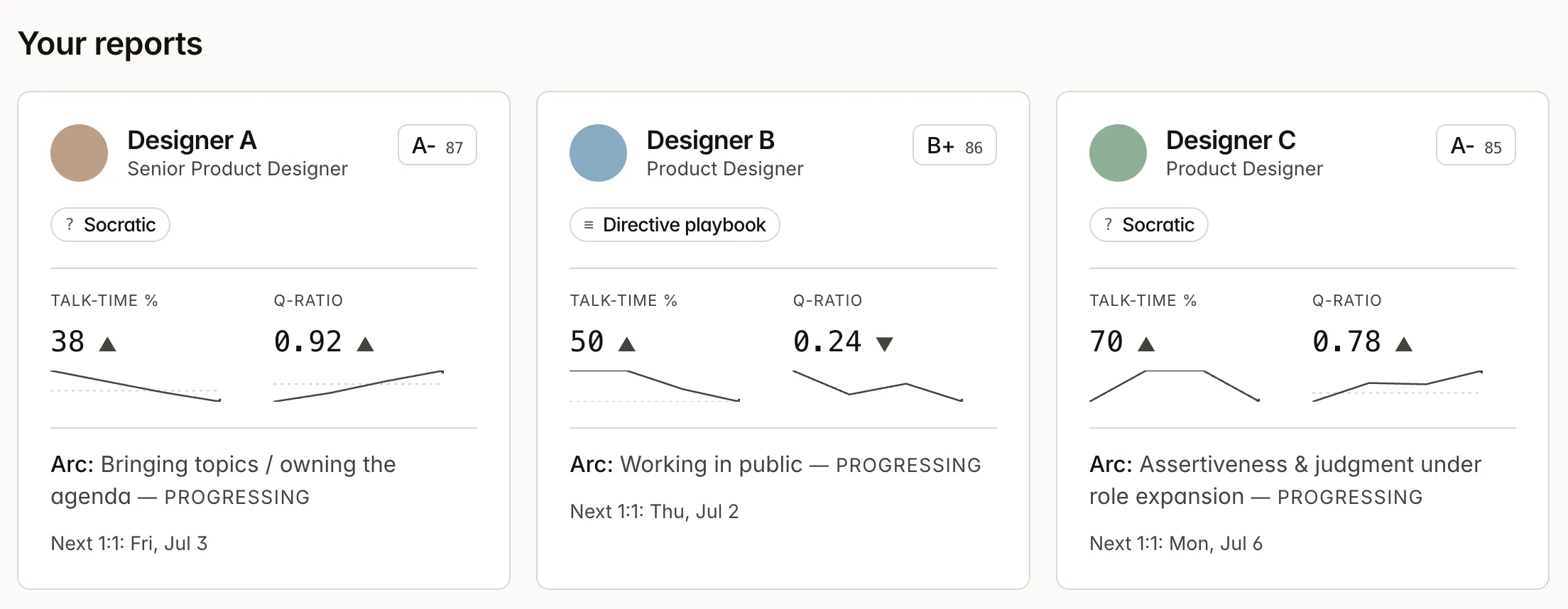
It caught me almost immediately. Over one stretch where I was being more directive with one of them, and so the scores dropped on the dimensions I cared about most.
Coaching-versus-directing went from “[they] arrived at the insight themselves” to “more directive […] approach prescribed rather than discovered.” Exactly what I didn’t want.
My talk-time ratio, already flagged as too high, went up further, worst during the strategy parts where I had the strongest opinions. The topic count jumped from around eight in a session, already too many, to roughly fifteen. My reflection on that week was that the best version of the conversation would have covered half the topics at twice the depth, with more silence after the open questions.
This is the part most managers never show: a dated record of catching myself coaching badly, and the specific dimension it failed on. The scorecard turned something I normally can’t see into a record I could track week to week.
The pattern behind the numbers was always the same:
The underlying trigger for over-talking seems to be when I have strong opinions about how to do something. I shift from coaching to instructing.
So the cue I came out with was almost embarrassingly small, a single question to ask myself mid-session. Have I asked a question in the last 2 minutes? It interrupts that moment, before it affects the designer.
A designer a few weeks in earned stakeholder trust, and credited the 1:1s
The calibration showed up fastest in the newer of the two. A few weeks into the role, they were already ‘designing out loud’: posting progress in public channels, recording Loom walkthroughs, having the stakeholder conversations directly instead of routing everything through me.
I wanted to know whether this was the coaching or just a strong hire. A project gave me the answer. I caught usability issues in another team’s work, and instead of fixing them myself I recorded a coaching Loom and handed it back. They explored four directions from the stakeholder feedback, chose an approach the stakeholders were excited about, and earned real trust doing it. When a leader praised the visibility, unprompted, the designer credited the 1:1 advice directly. It’s the kind of signal I trust most, because it came from someone other than me.
Situational leadership doesn’t mean changing who you are or what you want from a team; it only shows you what style to approach coaching opportunities with. It’s the first thing I’ll establish about any teams in the future.